The TED talk
In July this year I went to Oxford, England to talk about my year as a homeless woman, living in my van with my cat and my Rottweiler. I won the trip to TED in a contest sponsored by Daniel Pink around his book “Johnny Bunko.”
I’ll write more about that later, but the fact is, I got to TED, and got to speak. Today they posted the video of my talk.
Here’s the direct link to the TED talk page:
or http://www.ted.com/index.php/talks/becky_blanton_the_year_i_was_homeless.html
if you can’t click through. Just copy and paste that link in your browser window.
Here’s a shortened URL you can use to share it on Twitter: http://on.ted.com/4U
Here’s a direct link to my TED bio page: http://www.ted.com/speakers/becky_blanton.html
The whole reason I went public and was willing to tell people I was homeless was because I thought it was important that people know not all the homeless in America are addicted, mentally ill, down and out and begging in the streets. And for those that are, a great many of them are there because they lost everything and couldn’t find a way out, and so they turned to drugs and alcohol. For them, I want the message to be, “You CAN get out. You CAN get off the streets IF YOU WANT TO.” It takes a choice. It takes effort. It is not easy. I still struggle, but it gets easier. Believe it or not, there are thousands of homeless who enjoy not having any responsibility and who WANT to stay on the streets. But for those who want off and out - there is hope. I’m in the process of creating a website with talented graphic artist and musician David Benjamin Knopp.
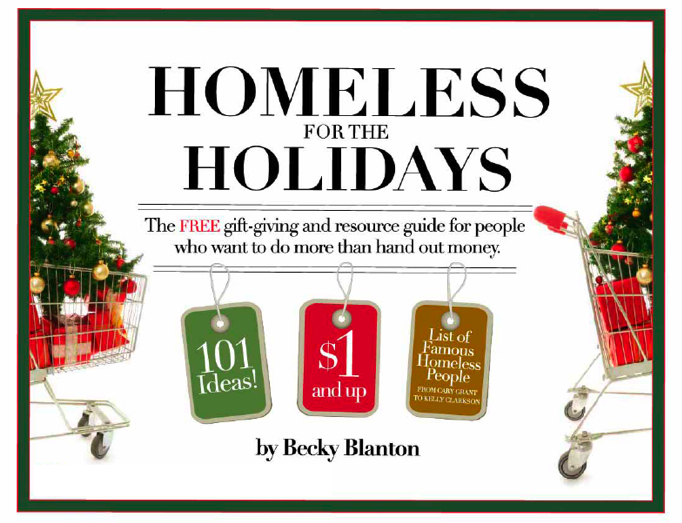
The site is called: http://homeless4theholidays.com and it’s going to be a resource center, a place with links, articles and stories about how to cope, how to get off the streets, how to change your situation (even if you aren’t homeless). I started with a free ebook: Click to download.
Homeless4holidayseBook
(It’s FREE!)
If you’re not homeless, chances are still pretty good you know someone who is. Someone who is couch surfing, or who moved back in with their parents. That’s comfortable homeless, but it’s still on the spectrum of homeless. You can’t afford your own place….and while it’s not the streets, it’s uncomfortably close.
I hope the ebook sparks ideas and conversations about homelessness in you and the groups you belong to. With the economy the way it is, the problem of homelessness and of people and families living in their cars, trucks and vans is only going to increase. You can’t simply drive people out of one area and into another as is the policy of cities and police departments. You can’t make homelessness someone else’s problem. It’s our problem. It became our problem when mental institutions turned out patients to the streets years ago. It became our problem when we warehoused prisoners rather than took the time to teach them job skills while we had a captive audience and could teach men and women to read (there’s an abnormally high rate of illiteracy in our prisons). It became our problem when we failed to address the social problems that lead to homelessness - like the lack of affordable housing, financial skills, credit and mortgage fraud.
But placing blame won’t solve this problem. Acknowledging we need to talk about it is what we need. If or when the health care act passes, 3.5 million people in America - that’s how many homeless people we have, and how many will be on the rolls. Let’s talk about this now.