Commenting on the Obvious
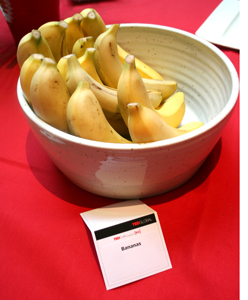
Shortly after a snapping a photo of a bowl of bananas with a tag that said, obviously enough, that they were “bananas,” a friend of mine and I laughed at how silly it seemed [then] to put a tag on something so obvious. Of course they were bananas! Then I rounded the table and saw several items, like Yorkshire Pudding, and some other exotic fruits and dishes I had no idea what they were. I heard a couple of Englishmen laughing at the idea that one would need to label Yorkshire Pudding. I was immediately humbled. I had assumed the entire world knew what a banana looked like, but obviously they had assumed everyone knew what Yorkshire Pudding looked like.
How often do we assume the same in relationships, work and every aspect of our lives? I was talking to a friend yesterday about why I wouldn’t mind the cold weather when going to my storage unit. “The ground is rock and the buildings form a natural wind break,” I said, “So it will actually be quite comfortable if it’s only 60 degrees outside. She paused for a minute. “I’ve never used a storage unit so I have no idea what they’re like or what they look like.” She’s always lived in a house, or moved from house-to-house and in 60 years has never needed or been to a storage unit.
Years ago I introduced a 45-year old friend to bowling. In the upper crusts of society where she grew up she’d never been bowling, or played putt-putt golf, or eaten a baloney sandwich. The things we assume are common to everyone, aren’t. I forget that not all my friends have done or seen the things I have. As a journalist I’m lucky. I’ve been exposed to a lot of things and have sought out a lot of experiences. But when I get lazy, I assume that others share my point of view, or my knowledge.
But like the Yorkshire Pudding, I don’t know what others know. When it comes to relationships, boundaries, feelings, expressing my needs and wants, or saying “No,” I often feel like I’m looking at something on a plate that looks good, but I have no idea how to eat it or what it is. Add to that confusion the fact that we all have a different upbringing, or understanding, or background around what “generous” is, or how friendship works, or how house chores are divided up, or how to negotiate responsibilities in ambiguous situations and things can get confusing. We long for tags that say things like, “Bananas,” or that spell out how we’re supposed to act or speak or respond.
But the fact is, I understand now, there are no hard and fast rules. There are guidelines and social mores, and etiquette and so on for general situations, but there is no one writing the rule book for your life but you. And until you decide what you need, what you want, and what you’re willing to spend or take for those things - you’ll spend a lot of time not being able to understand what’s on the table.
Sometimes. like at TED, there won’t be a name tag and no one around you will know what something is. You can decide to take a chance and risk tasting the food, or the job, or the relationship and decide then if you want to continue with it.
Yes - I’m wringing every last metaphor out of this photo and event that I can - but only because it’s so true - that we depend on labels, and not so much on experience. Will a tag telling me that a banana is a banana make the fruit taste differently? I tasted the Yorkshire Pudding only because I’d read and heard the name so often I was curious about it. Just looking at it on the table I’d have passed it by.
Moral of the story: The “obvious” is only obvious to those who have experienced it. There’s really no such thing as obvious. Obvious is just shorthand for, “I know that.” Remember that and don’t forget that there’s no shame in looking for the tags, or creating your own. Tags are just maps - telling us where we’ve been, showing us what is still out there to discover.